Future complex:
Tad Homer-Dixon confronts the gap between global problems and solutions.
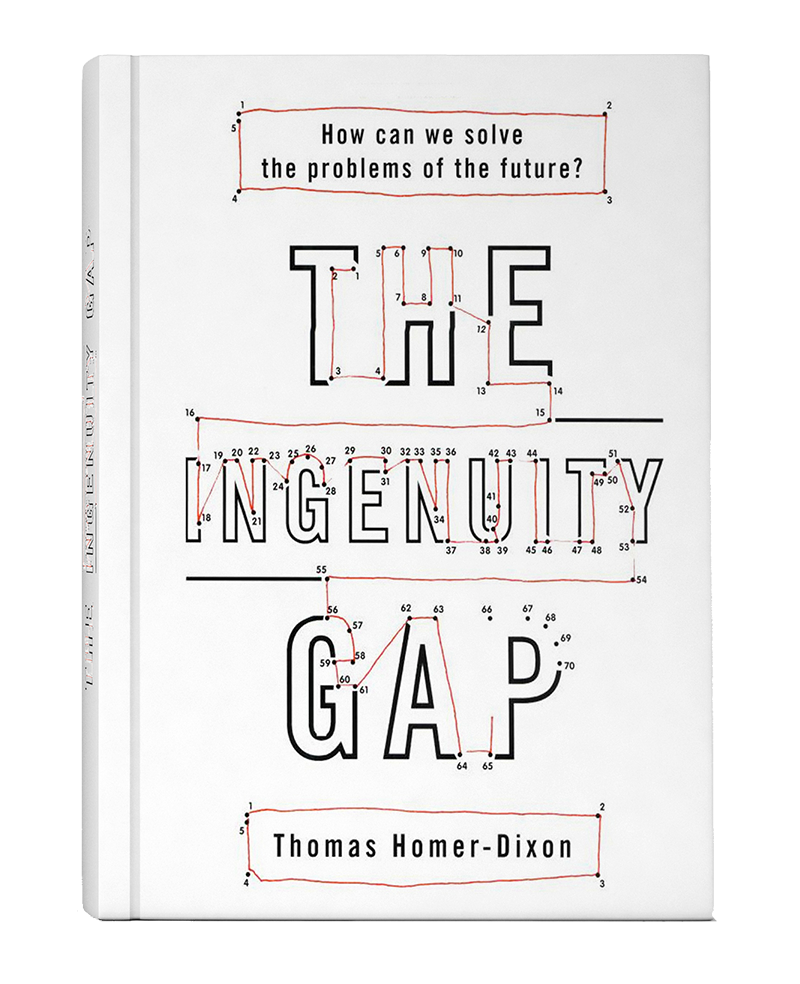
By BRIAN BETHUNE Maclean's Oct 30, 2000, p. 56 Five years into
the eight-year odyssey that was the writing of The Ingenuity Gap, Thomas (Tad)
Homer-Dixon found himself overwhelmed by the complexity of his project. So he did
what he does very well in his intricately argued book about the problems facing
global civilization. He paused to take stock, and to break his intractable mass
of data into manageable bits. The University of Toronto political scientist
calculates that he had accumulated more than 100 km of paper in his small home
office. Materials for the first third of the book alone filled 35 banker's boxes.
"I'm living the problem I'm describing," Homer-Dixon despairingly told his
editors at Knopf Canada, before summoning up the personal ingenuity to cope, by
dividing his narrative into three more workable strands -- thematic, geographical
and metaphoric. It's a good thing he persevered, because Homer-Dixon is
one of the few people on the planet who could have tackled what he defines as the
world's overriding issue: the yawning "ingenuity" gap between the need for
practical solutions to complex problems, from global warming to Third World
poverty, and the actual supply of workable ideas. For most of the past decade,
the 44-year-old director of U of T's Peace and Conflict Studies program has
combined demographics, economics, and environmental and military conflict
analyses with an eye to making sense of various crises around the world.
Homer-Dixon's pioneering work has brought him to the attention of policy-makers
in the United States, where he has twice briefed Vice-President Al Gore, and
Canada, where he interrupted his book tour last week for a 90-minute discussion
with Privy Council Office staff in Ottawa. The Ingenuity Gap ranges over
the world, discussing the barriers -- mostly attitude and political will -- that
prevent humanity from dealing effectively with its vital concerns. Homer-Dixon
does a superb job in one of his primary aims, "making complexity simple enough to
understand." Much of his attention is focused on the great natural systems that
allow life on the planet to flourish. Time and again he interviews experts who
are just beginning to learn how little they know. Seismologists, for example, now
see their goal of accurate earthquake prediction -- widely believed 20 years ago
as being almost within their grasp -- receding the more they learn about the
factors involved. Climate is another favourite example. Columbia
University geochemist Wally Broecker points out that there have been abrupt
climate changes before, the result of previous "nonlinear" eruptions. It is
entirely possible, in Broecker's view, that incremental global warming will cause
the main North Atlantic current to shut down and plunge Europe into a
Siberian-style climate. Or maybe it won't. Broecker's point -- and Homer-Dixon's,
too -- is simply that we don't know, but continue to act as though we do:
"Climate is an angry beast, and we are poking it with sticks." The core argument
of The Ingenuity Gap is that there is considerable reason, given the number and
nature of environmental "insults" humanity is inflicting on the planet, to expect
that global systems will not always carry on as before. That conclusion puts the
native of Prospect Lake, near Victoria, the only child of an artist mother and a
forester father, at odds with crucial aspects of Western thinking. Homer-Dixon
argues that economic optimists, those who think market signals and technology
will guide the world safely through any future shocks, are dangerous. They have
the ear of governments, he notes, and their influence helps keep humanity on a
collision course with nature. Despite considerable convergence in their
diagnoses, Homer-Dixon also parts company with those he considers environmental
pessimists. "I'm fed up with being labelled a doomsayer," he says. "What
separates me from them is that I'm pretty impressed with human beings, their
creativity and adaptability. I emphasize technical solutions." But Homer-Dixon
acknowledges that the questions and solutions he raises are "ultimately
spiritual." A profound change in attitude, he says, from arrogance towards
natural systems to a more humble assessment of "our strengths, weaknesses and
ignorance" would go a long way to bridging the ingenuity gap. Back to Full List of
Reviews
Home |
Book Contents |
Book Excerpt |
About Thomas Homer Dixon |
Order The Book
Copyright 2000 Random
House, Inc. | Alfred A.
Knopf |