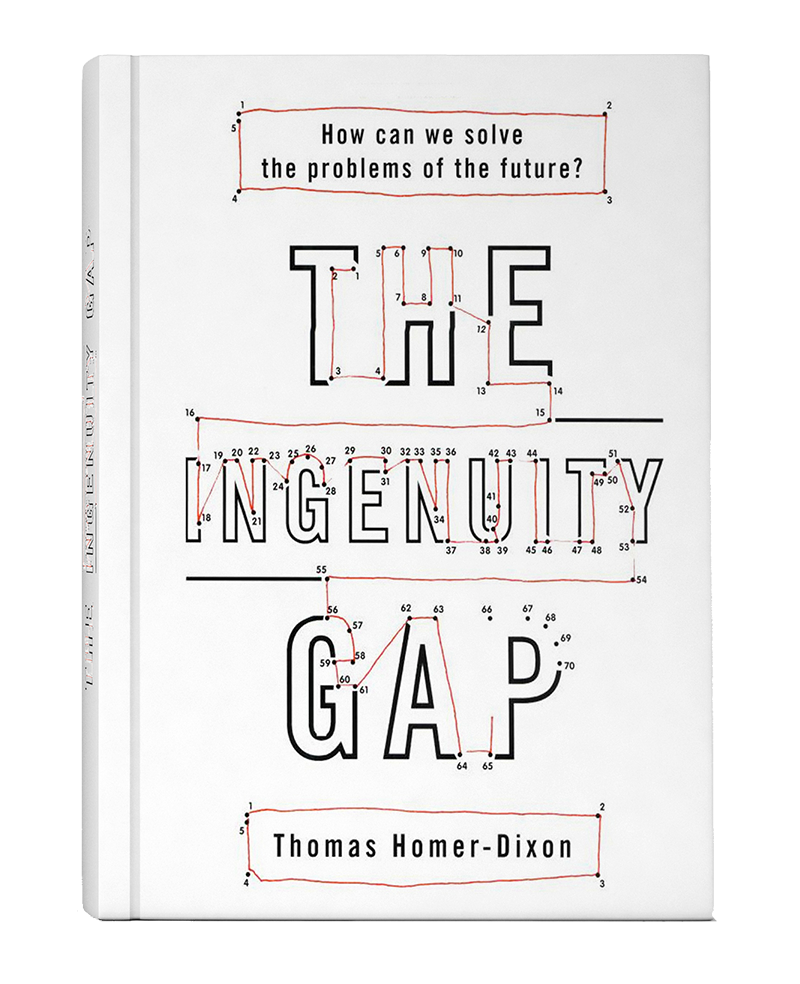
The Ingenuity
Gap: How can we solve the problems of the future?
By HAROLD
HEFT Southam News There's good news and there's bad news, and Thomas
Homer-Dixon, in his expansive new book The Ingenuity Gap: How Can We Solve the
Problems of the Future?, is going to give us the bad news first. To be exact,
Homer-Dixon provides nearly 400 pages of bad news before the payoff, 10 or so
pages of pale, qualified hope. Homer-Dixon is one of a handful of young
Canadian pundits poised to occupy a place on the world stage as a broadly
influential political commentator of international calibre. His credentials are
impressive. Currently director of peace and conflict studies at the University of
Toronto, Homer-Dixon did his graduate work on the subject of social conflict at
the Massachusetts Institute of Technology, and has since participated in numerous
projects studying the relationship between environmental scarcity and conflict,
most notably in a CIA-sponsored State Failure Task Force reporting directly to
U.S. Vice-President Al Gore. The concept of an "ingenuity gap," or the gap
between humanity's ability to create environmental, social and technological
problems and its ability to solve them, has been preoccupying Homer-Dixon since
at least 1995, when he published a paper by the same name in the Population and
Development Review. Since then, the majority of his work has in some way
attempted to grapple with this central theme: Can the world population resolve
the crises it has already created, as well as the much greater problems on the
horizon, or have we already doomed ourselves? Homer-Dixon's extensive work
in the subject enables him to provide readers with an impressive catalogue of
environmental, social, political and technological hazards that currently exist
around the Earth, most notably overpopulation, overexploitation of resources,
global warming and the scarcity of unpolluted, fresh water. Equally impressive is
his skill at probing the evolution of the human mind in his search for clues as
to whether we have the mental capacity to heal our planet. The timing could
not be more ideal for the publication of The Ingenuity Gap. While reading through
Homer-Dixon's analyses, I paused occasionally to watch televised newscasts and,
as if world events were scripted to correspond to the book, I witnessed, in
sequence, political unrest in Yugoslavia, U.S. presidential debates (starring Al
Gore, who had personally asked Homer-Dixon to study "the impacts of nature on
society"), clashes between Israelis and Palestinians, and the recent terrorist
attack against the USS Cole. These events seemed almost perfectly choreographed
to illustrate Homer-Dixon's argument that the wealthy populations of the world
enjoy only a simulacrum of order, beyond which the careful observer should detect
signs of social and environmental decline and potential chaos. (While watching
these stories unfold, I also waited with my nine-months-pregnant wife for our
first child to be born, forced to wonder about the state of the world that our
child was to inherit.) Homer-Dixon attempts to dramatize the "ingenuity
gap" by weaving a series of interrelated narratives, each of which, the reader
understands, has the potential to reflect some insight on our social dilemmas.
The most compelling of these narratives is the story of United Airways Flight 232
which, in July 1989, experienced an explosion in its tail engine resulting from a
small crack in the engine's fan disk. The flight's crew, responding to the
emergency with teamwork and sufficient ingenuity to alter rules and instructions,
was able to crash-land the plane, saving the lives of approximately two-thirds of
the passengers. According to Homer-Dixon, the incident can be interpreted as a
metaphor for "a world of converging complexities and connections" and for "crisis
and the sharp, unexpected, blinding events that sometimes send us
reeling." More personal narratives provide Homer-Dixon with the opportunity
to reflect broadly on the nature of the world we have created. His travels
through Canary Wharf in London, Las Vegas and the wilderness of Vancouver Island
enable him to expand with ease and finesse into issues of human technological
achievement, socioeconomic inequality and the potential for calamity around the
globe. A photo that he had taken of a small girl in India during his travels, and
his subsequent decision to try to find that girl again, lead to questions of the
connectedness between people around the world and our communal responsibility for
one another. The greatest strength of The Ingenuity Gap is in
Homer-Dixon's ability to illustrate the thin line between order and chaos,
prosperity and starvation, or compassion and carelessness in today's world. The
book is a wake-up call to all citizens to take notice of our collective
deterioration and therefore, if widely distributed and read, it has the potential
to be one of the most important and revolutionary books of recent years.
It is difficult to identify Homer-Dixon's specific readership, however, since he
shifts often and abruptly between an anecdotal, accessible writing style and an
intensely academic, technical approach, which has the potential to alienate both
academic and casual readers. It should also be noted that, while
Homer-Dixon proves adept at presenting the reader with lists of problems
confronting the world, his answers to the question posed in the subtitle of the
book, "How can we solve the problems of the future?" seem facile and
unconvincing. While traveling through one of the poorest and most politically
corrupt regions of India, it suddenly, inexplicably, occurs to him that "as some
resources become scarcer, societies can maintain or raise their standard of
living by supplying more ingenuity," though there is absolutely no indication of
where he found evidence to lead him to so sanguine a conclusion. Even as
Homer-Dixon attempts to conclude poetically with such pronouncements as "We need
imagination, metaphor and empathy more than ever, to help us remember each
other's essential humanity," his sentiments ring false, and the reader senses
that there are simply no easy answers to the challenges described in The
Ingenuity Gap. In truth, the solutions to the problems raised by Homer-Dixon
cannot be articulated in a few concluding paragraphs; they will only be
formulated over many years and many volumes, and they will not be found in the
work of one writer, but will instead require a collective, international effort
of unprecedented proportions. Author and Montreal native Harold Heft is
director of advancement and communications at the Canadian Institute for Advanced
Research in Toronto. Back to Full List of
Reviews
Home |
Book Contents |
Book Excerpt |
About Thomas Homer Dixon |
Order The Book
Copyright 2000 Random House, Inc. | Alfred A. Knopf |